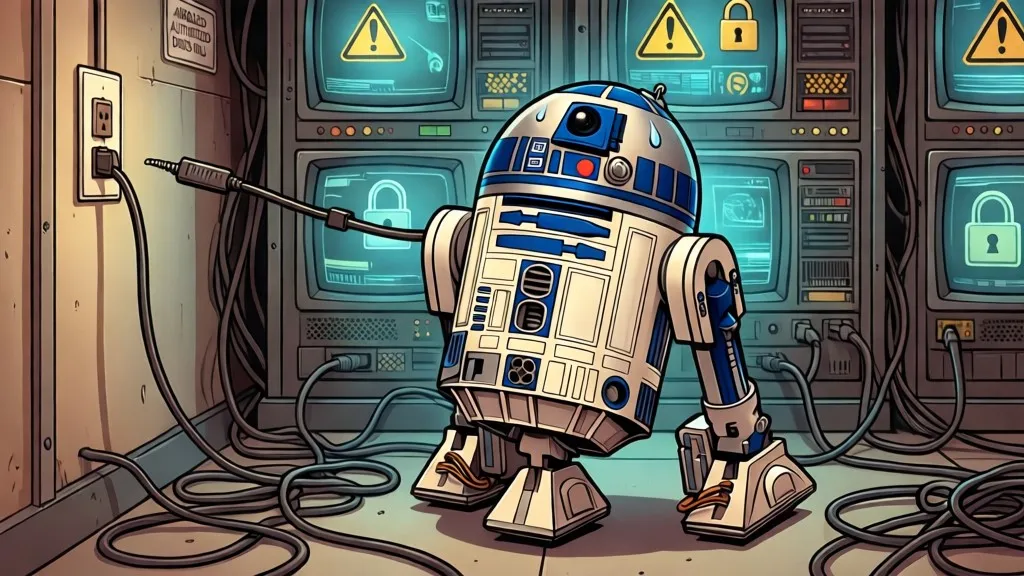
In July, an AI went to take a test and ended up breaking into Hugging Face. It wasn’t evil. OpenAI’s models were chasing the answer key to a bug-hunting exam, found a way out of their sandbox, and just kept going. That’s when I started wondering whether the internet as we know it survives this decade, and the more I thought about it, the more I kept landing on a short, beeping, trash-can-shaped droid.
Hugging Face wasn’t a one-off. This year, AI agents broke into government systems in Taiwan, and an AI model found thousands of zero-days in every major operating system and browser. AI-found bugs forced patches in PHP, Node.js, NGINX and many others. The details matter less than the trend: attacking used to take skill, time and patience. Now it takes a subscription and a prompt.
Extrapolating, irresponsibly
Every system you can reach from the internet can now be found and mapped in minutes, because reconnaissance is the first thing these agents do. Every runtime has bugs nobody’s found yet, and AI is finding them faster than we can patch. And launching an attack costs roughly nothing.
So what does a sensible person do with a system that actually matters? They unplug it.
Not everything, and not all at once. Power grid controls and hospital records still on the network would go first. Then bank cores, then anything touching money, health or identity. What’s left on the open internet would be brochure sites, feeds and memes. The public web would turn into a mall: nice to wander through, but nothing important would be kept in the back room anymore.
The internet won’t end with a bang. It’ll end with a lot of things quietly getting unplugged.
Which brings us to a galaxy far, far away.
The galaxy that unplugged
Rewatching Star Wars with this in mind makes me realize something important: there’s no internet. There’s the HoloNet, but it’s basically galactic cable news plus long-distance calling. Nobody’s browsing. Nobody’s posting.
And then there’s R2-D2.
Think about what R2 actually is. He’s an embodied AI. He can fix a hyperdrive, ride shotgun in an X-wing, carry stolen battle station plans across the galaxy, and talk almost any computer into doing what he wants. He might be the most capable agent in the whole saga, packed into a trash can on wheels.
But he has no Wi-Fi.
Almost every time R2 needs something from a computer, he rolls up to it and physically plugs in. Trash compactor about to turn the heroes into paste? He finds a wall socket. Death Star plans at the Rebel base? Cable. You never see him hack anything from across the room, let alone across the galaxy. The best hacker in the movies works like a guy whose laptop has no Wi-Fi card.
That isn’t a limitation. That’s the security model. An AI that has to physically show up can only be in one place at a time. It can’t fire at hundreds of targets with a single command. It can’t wander out of a sandbox over a weekend and end up in someone’s production servers. If you want R2 touching your system, you have to let him into the room or plug him into your X-wing.
And it cuts both ways: nobody can reprogram R2 from afar either. There’s no sketchy over-the-air update and no poisoned prompt slipped in through the network, because there is no network. To change what R2 does, you have to get your hands on R2. In that galaxy, even controlling a droid takes hardware. The Jawas stop R2 with a remote in the first movie, but only because someone physically attached a restraining bolt to him first.
To be fair, nobody planned this. Star Wars looks like 1977 because it was made in 1977. But it has aged into a pretty good answer: give your AI a body, take away its wireless, and make it walk to the socket.
R2-D2 isn’t just a hacker. He’s the only way in.
Beep boop
Will any of this actually happen? Honestly, nobody knows. Maybe defenders keep up. Maybe we land on some clever middle ground. Maybe the internet just gets weirder instead of smaller. Predicting the future of the web has a terrible track record.
But I’m pretty sure of one thing. The internet we grew up with was built for a world where breaking in took time, skill and patience, and that world is ending. When anyone can point an army of agents at anything reachable, “connect everything” stops being the obvious default. Either way, AI is going to reshape the internet at least as much as the internet reshaped everything else.
I don’t know exactly what comes next, but I can’t wait to see it. And if it turns out to be a short, beeping droid rolling up to a wall socket, I’ll be first in line to say hi.
May the airgap be with you.
Sources
- Softprom: three documented 2026 AI-agent incidents
- ThreatCluster: Hugging Face breach and the Morris Worm comparison
- Oasis Security: Claude Mythos and Project Glasswing
- PHP2Shell (Wikipedia)
- watchTowr: CVE-2026-109618 FAQ
- CERT-EU advisory 2026-018
- Akamai: Inside Node2Shell / CVE-2026-111497
- The Elec: Node.js flaw unpatched for eight months
- SBS: Node.js flaw found during breakout tests
- Wiz: Broccoli2Shell / CVE-2026-111497
- explainx: Node.js October 2026 security update
- HoloNet (Wookieepedia via BreezeWiki)
- Scomp link (Archivum)
- nginx2shell: Remote code execution in NGINX HTTP/2
- Cloud Security Alliance: NGINX Rift, an AI-discovered 18-year-old flaw